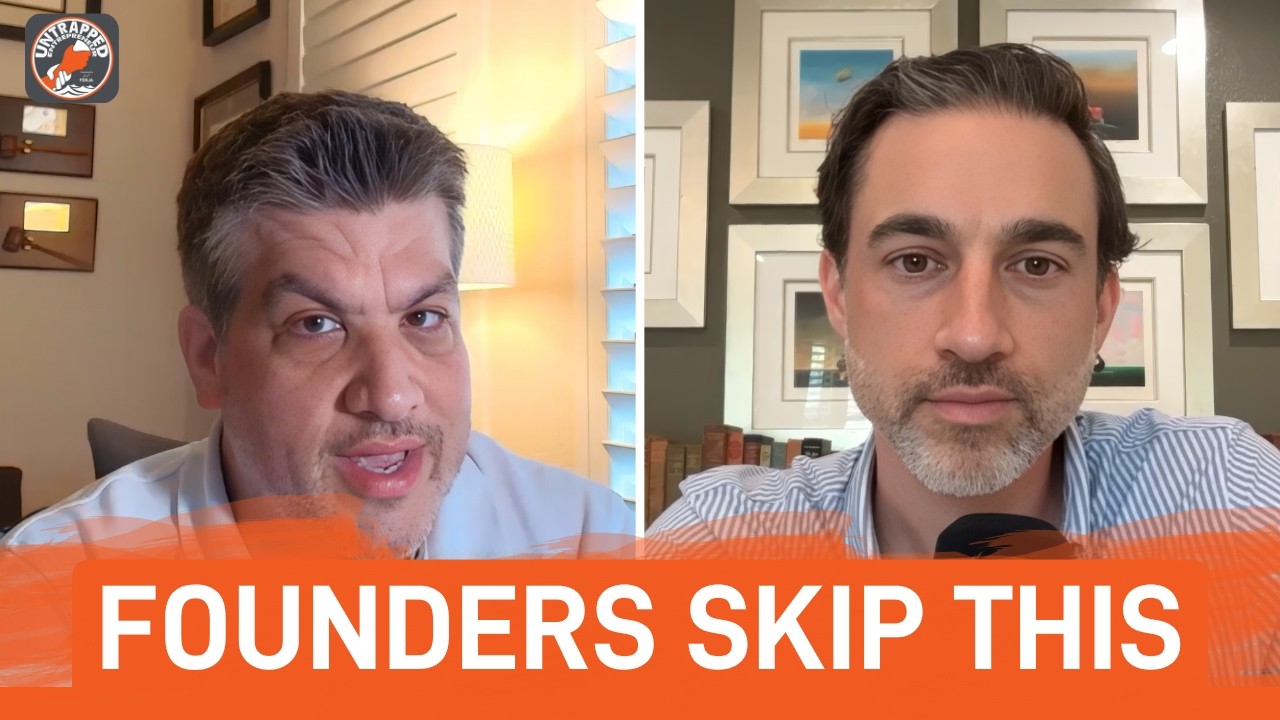
The beginning of a business is full of motion. There is a name to choose, a customer to win, a website to launch, and revenue to create. Legal work can feel like something to clean up after the business proves itself. Business attorney and entrepreneur Matthew Fornaro sees that assumption become expensive again and again.
Matthew started his own firm after years inside large law practices. Becoming an owner forced him to learn the side of business law school never taught him: payroll, insurance, rent, marketing, systems, and the weight of making decisions with his own money at risk. That operator's perspective changed the advice he gives.
The law cannot guarantee a good business. A sound legal foundation can help the business succeed or fail on its merits instead of collapsing because a preventable issue was ignored.
When eagerness becomes a liability
Matthew's most common warning is simple. Founders are so eager to get started that they skip the due diligence and foundation work that should come first. They file an LLC online and treat the confirmation email as proof that the business is protected.
Formation is one step. It does not answer how owners make decisions, what happens if a partner leaves, who owns the work being created, how a customer relationship is governed, or whether the company is actually observing the formalities behind its chosen structure.
Speed can create momentum. It can also carry an avoidable mistake much farther than it needed to go.
Some companies have enough time and money to repair the missing pieces later. Others discover the problem during a dispute, a financing round, a sale, or a crisis. At that point, the cost is no longer just the fee to prepare a document. The business may be negotiating from a position of weakness.
What a real business foundation includes
The right documents depend on the company, its owners, its location, and the work it does. Matthew's broader point is that every founder should understand what was chosen and why.
Governance between owners
An operating agreement, bylaws, and related formation documents clarify authority and expectations. They should address how decisions are made, what owners contribute, how profits are handled, and what happens when the relationship changes. A handshake can reflect trust. It cannot anticipate every difficult season.
Written expectations with customers and vendors
Contracts are where the business explains what it will do, what it expects in return, and what happens when reality does not match the plan. Terms of service, vendor agreements, commercial leases, and customer contracts are not generic paperwork. They allocate risk.
People policies that match the company
Employee handbooks, operating procedures, confidentiality terms, and other workplace documents become more important as the team grows. Waiting until a conflict arises leaves leaders trying to create the rule while applying it.
What could go wrong in this relationship, and have we agreed in writing on what happens next?
AI is a useful draft, not a final decision
Matthew uses AI in his own practice and business. He sees it as a force multiplier and a genuine time saver. He also sees clients arrive with AI-generated documents that range from useful starting points to completely wrong answers presented with total confidence.
The problem is not that founders use AI. The problem is surrendering judgment to it. A document can look polished while using the wrong law, missing a critical fact, or solving a different problem. The founder still owns the consequences.
Matthew's advice is practical: use AI if it helps, then have the appropriate professional review the result. The professional's value is not a signature at the bottom of a page. It is the ability to understand the facts, compare possible paths, explain tradeoffs, and know when the obvious answer does not fit the situation.
AI will often agree with whichever option the user proposes next. Good advice requires someone willing to say why path B creates a risk that path A does not, and what that difference means for cash, timing, control, and liability.
Protect the value while you are creating it
Ben shared his own hard lesson about intellectual property. He chose a product name, invested in packaging, and later learned that a major company had already filed an intent to use the mark. He ultimately kept the name, but only after two years and significant legal work.
Matthew's response gets to the heart of the issue: intellectual property is still property. A founder would not leave cash sitting outside the business and hope nobody took it. A brand name, product, service mark, or trade secret deserves the same early attention.
The right time to investigate ownership and protection is before the business becomes emotionally and financially attached to the asset. The more value the company builds around an unprotected name or idea, the more painful a conflict becomes.
Build the company you meant to build
Legal preparation is not about turning every decision into fear. It is about clearing preventable obstacles so the founder can focus on serving customers and building a healthy business.
Ask for help before the agreement is signed, before the name is printed, and before the conflict begins. The goal is not perfect protection. It is to make informed decisions while there are still good options available.