
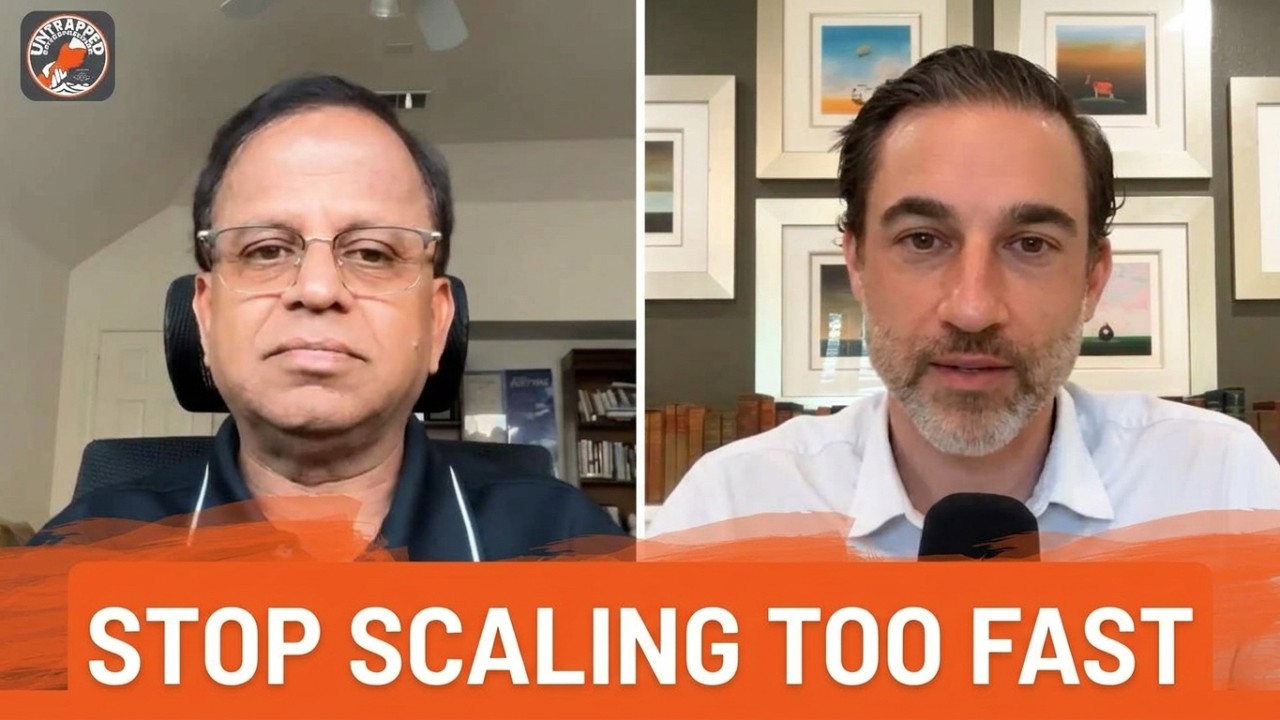
Entrepreneurs are trained to want growth. More customers, more revenue, a larger team, and a bigger footprint are often treated as proof that a company is working. Kalanithi Venkatesan learned that growth can also expose every weakness a business has been able to hide.
Before founding 4See Advisory, Kal built and sold a professional services company. His experience taught him that an opportunity to grow is not automatically an opportunity a company is ready to take. If leadership, cash, and sales capacity are out of balance, the same growth that looks exciting on the outside can make the business more fragile.
The wrong question is, “How fast can we grow?”
At one point, Kal and his partner considered an acquisition that could have added millions in revenue. On paper, it looked like a fast path toward the next target. In practice, the process began pulling time, attention, and energy away from the healthy business they already owned.
That experience reframed the decision. The issue was not whether the opportunity was real. The issue was whether the organization could absorb it without damaging the foundation underneath it.
Growth is only healthy when the business can carry it.
A useful planning exercise is to imagine revenue growing by 50 percent next year. Then ask which part of the company would fail first. Would decisions pile up at the founder? Would cash disappear into payroll and inventory before customers paid? Would the sales team create work the operation could not fulfill? The first honest answer reveals the real growth constraint.
Three signals that the business is ready
Kal looks for three conditions before pursuing an aggressive growth target.
1. Leadership that can make decisions without the founder
A company cannot scale if every important question returns to one person. The leadership team needs clear responsibility, sound judgment, and the authority to act. Otherwise, growth multiplies decisions faster than the founder can make them.
2. Enough cash to survive the gap
Growth often consumes cash before it produces cash. New people, equipment, inventory, systems, and marketing arrive before the corresponding revenue is collected. A profitable company can still run into trouble if it does not have the liquidity to carry that gap.
3. A sales system that is repeatable
One founder with strong relationships can create impressive revenue. That does not mean the company has a sales engine. Healthy scaling requires a process other people can learn, measure, and improve without depending on the founder's personal effort.
Do we have the leaders, cash, and sales capacity to support the goal at the same time?
When more capital weakens discipline
Entrepreneurs usually think of limited capital as the trap. Kal also warned about the opposite. Too much money can make weak decisions easier to justify.
A larger office, a senior hire the company does not need yet, or another round of product features can each sound reasonable in isolation. Together, they can consume the runway the company will need when conditions change. Money should expand the ability to execute a clear strategy. It should not replace the discipline required to choose one.
This is why restraint matters even when the bank balance is strong. The question is not whether the business can afford a decision today. It is whether the decision strengthens the company it is trying to become.
Build for the exit before you are ready to leave
Kal's mentor encouraged him to put both a number and a date on his exit goal. That forced the team to think years ahead. They strengthened financial reporting, developed leaders, protected customer relationships, and created operating processes that did not require the founders at the center of everything.
Those choices made the business stronger long before a buyer appeared. Clean financials reduced uncertainty. Capable leaders made continuity believable. Strong customer relationships lowered perceived risk. The company became easier to trust because it could stand on its own.
Kal also carried a conviction about sharing the upside with the people who helped build the company. An exit can become another trap if founders treat it only as the final score. The transaction should reflect the work, loyalty, and responsibility that made the outcome possible.
The lesson to carry forward
Growth is not the enemy. Unexamined growth is. The wiser goal is to build a company that becomes stronger as it gets larger, and more capable as the founder becomes less central.
Before chasing the next number, look at the systems that must carry it. Strengthen the weak point first. The opportunity will still be exciting, but it will be far less likely to become the trap.